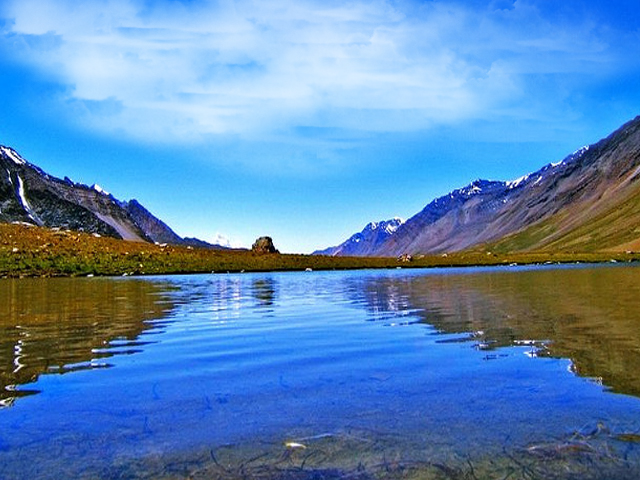
Wednesday, February 6, 2013

BALTORO GLACIER (Gilgit- Baltistan, Pakistan)


Located in Pakistan in the Gilgit-Baltistan region Baltoro Glacier is one of the longest glaciers outside the Polar Regions. It is 62 kilometers long and. runs through part of the Karakoram mountain range. Baltoro Glacier is the world 4th longest glacier outside the Polar Regions.


Baltoro glacier is situated on the southern slopes of the central Karakoram range in the Baltistan area of Jammu and Kashmir. Large tributary glaciers include a glacier from the southwestern slopes of the Gasherbrum peak and a tributary glacier from the northwestern slope of the Masherbrum peak, both in the Karakoram, are fed into Baltoro stretching its length about 62 kms.


Several large tributary glaciers feed the main Baltoro glacier, including the Godwin Austen Glacier which flows towards south from K2. Abruzzi Glacier and various Gasherbrum Glaciers flows from the Gasherbrum group of peaks. the Vigne Glacier, flows from Chogolisa, and the Yermandendu Glacier flows from Masherbrum.


The confluence of the main Baltoro Glacier with the Godwin Austen Glacier is known as Concordia.  Concordia is popular trekking destinations because it provides view of renowned and highest peaks of the world. Out of which four peaks are included in eight thousander, which are, the K-2 (8611 m.) 2nd highest peak of the world, Gasherbrum- l (8,080m) 11th highest of the world, Broad Peak (8047 m.) 12th highest of the world, Gasherbrum- ll (8,035m) 13th highest of the world  and other highest and notable peaks such as Gasherbrum Group peaks, Marble Peak,  Golden Throne (7312 m.), Chogolisa (7654 m.) and Mitre Peak (6038 m.) lies in Baltoro Glacier.


A list of notable peaks adjacent to or near the Baltoro Glacier includes:

  • K2, 2nd highest of the world at 8611m
  • Gasherbrum I, 11th highest of the world at 8,080m.
  • Broad Peak, 12th highest of the world at 8,047m.
  • Gasherbrum II, 13th highest of the world at 8,035m.
  • Gasherbrum III, 7,946m. (Often regarded as a subpeak of Gasherbrum II.)
  • Gasherbrum IV, 17th highest of the world at 7,932m.
  • Masherbrum (K1), 22nd highest of the world at 7,821m.
  • Chogolisa, 36th highest of the world at 7,665m.
  • Muztagh Tower, 7,273m.
  • Snow Dome, 7,160m.
  • Biarchedi, 6,781 m
  • Uli Biaho Tower, 6,417m.
  • Trango Towers, 6,286m. (Their vertical faces are the world's tallest cliffs.)
  • Mitre Peak, 6,010m.


The trek on the Baltoro Glacier provides with ultimate mountain scenery of well known mountains such as Masherbrum (7852 m.), Uli Biaho Tower (6190 m.), Trango Towers (6300 m.), the Grand Cathedral (5228 m.) and Muztagh Tower (7273 m.)
 

Baltoro Glacier’s trough is very wide. Small valley glaciers form icefalls where they meet the trunk glacier. The sidewalls vary from very steep to precipitous. Moving ice has formed depressions, which serve as basins for numerous glacial lakes. There are rocky moraines and ablation valley .This glacier is enormous reservoirs of fresh water and its melted water is an important resource which feed the river Baltoro Glacier is one of the sources of Shigar River, a tributary of the River Indus.

Baltoro Glacier Provides breathtaking scenic beauty  and excellent views of peaks.the sight of Baltoro pinnacles and Paiyu Peak is astounding


Monday, February 4, 2013

Shah Jahan Mosque( Thatta - Sindh) Pakistan


Shah jahan Mosque is famous for its beautiful architecture. It in located in Thatta city, Sindh province of Pakistan. This Mosque was built in the reign of Mughal emperor Shah Jahan. The foundation of the mosque were laid in 1644 A.D and mosque was completed in 1647 A.D. This Mosque is called with many names like Jama Masjid Thatta,  Shahjahani Mosque and Badshahi Mosque Thatta 


The mosque is a excellent example of crafty tile work.The mosque is built with red bricks with blue coloured glaze tiles.  The domes have been exquisitely laid in a mosaic of radiating blue and white tiles. Its blue tiles and mosaic work are very appealing. The mosque is combination of Turkish and local artwork, which is profusely used on tile work in the ceiling decoration of semi domed and domed chambers; as well as in the fillings of interlaced arches. This new concept reveals Mughal influence in the types of of geometric lines that enclose these stars to make different patterns. 


The Shah Jahan mosque represents the beautiful  tile decoration of Sindh. This mosque is a prime example of an imperial architectural form of region by the use of brick and Sindh tile work.There is mosaic tile work on the ceiling decoration of semi-domed and domed chambers, as well as in the fillings of interlaced arches and in the panels. Stylish floral patterns and Kashi work, decorate the spandrels of the main arches Their domes have  been exquisitely laid with a mosaic of radiating blue and white tiles.Various shapes of tiles  are square, rectangular and hexagonal which were manufactured and joined to complete a design in a given panel.  Various shades of blue on white, and some yellow or purple background produce a very soothing effect in the hot climate of Thatta.


The mosque is a heavy brick structure of simple construction built upon a stone plinth, with heavy  square pillars and massive walls, is centered around a courtyard 169' X 97'. The prayer chamber is of  a similar size. Both are covered by large domes. On the north and south two aisled galleries open by  means of arcades onto the courtyard. Ninety three domes cover the entire structure, and are probably  the cause of a remarkable echo, which enables the prayers in front of the Mibrab to be heard in any  part of the building. The mosque contains the most elaborate display of tile-work in the Indo-Pakistan  sub-continent. The two main chambers, in particular, are entirely covered with them.. 


The mosque is spread over an area of 51,850 square feet. The main entrance of the mosque has a central domed chamber. The mosque has an open central courtyard of about 15,900 square feet. Arcades of red brick arches highlighted with bands of white surround the courtyard.


 The ablution pond is located  a square courtyard located within the eastern portion of the mosque.The domes and arches can be seen as a  series of lined arches in straight line. Each arch has a small atop with beautiful mosaic and tile work.


 The main quality of Shah Jahan Mosque is that it has no minarets. Instead of the typical three domes, there is only one main dome in the prayer hall. Its 93 domes and 33 arches with varying sizes add to their architectural beauty. It is world's largest mosque having such number of domes.


It has been built keeping acoustics in mind. A person speaking inside one end of the dome can be heard at the other end when the speech exceeds 100 decibels.


Thursday, January 31, 2013

SNOW LAKE (Pakistan)


Snow Lake is a high-altitude glacial basin in the Karakoram mountain range in the Northern Areas of Pakistan. It is also called Lukpe Lawo. It is located 16,000 feet (4,877 m) above sea level, and is approximately 10 miles (16 km) wide and 61 mile (100 km) long.


At the head of the Biafo Glacier and at the foot of the Hispar Pass is 'Snow Lake' This spectacular beauty of this natural wonder is enhanced by the presence of the Ogre or Biantha Brakk, which is the highest peak in the Region. Such is the stunning beauty of this Region combined with its wealth of magnificent snow clad peak, that it is hard to identify any one peak as being.


The Snow Lake Trek , also known as the Biafo-Hispar Trek is one of Pakistan's greatest treks. It has been rated as one of the top five treks in the world for its extreme beauty and adventurous nature.


Biafo Hisper trek starts from Skardu –Askoli.. The trek from Askole initially proceeds towards K2, then turns northwest up the Biafo Glacier to Snow Lake. The route is formed by the Biafo and Hispar Glaciers which form the longest continuous stretch (114km) of glacier in the Karakorums. This icy highway takes trekkers deep into the mountains towards Snow Lake, the large glacial basin formed by the Lukpe La and Sim Glaciers.


 Most groups start this trek from the village of Askole in Baltistan's Shigar Valley and end in the village of Hispar in the Nagar Valley. Over two-thirds of the trek is on glacier, which can be very demanding, but most campsites are off the glacier in beautiful meadows with impressive.


Trekking across Snow Lake requires traveling in roped teams due to the danger of hidden crevasses, but the walking is not difficult. Crampons are not needed, but because the route can be difficult to follow, an experienced guide is necessary. This is also one of the longest treks in Pakistan. From Gilgit to Gilgit it normally requires at least 16 days depending on fitness and weather. The descent differs from the ascent, going through the Hunza Valley and ending in Gilgit.


On the trek one can observe the rare species of animals in abundance like snow leopards, Himalayan Bears, Ibex, and Marco polo Sheep.


Snow Lake is surrounded by towering peaks and magnificent granite spires, creating what has been called some of the finest mountain scenery in the world.

Tuesday, January 29, 2013

Karambar Lake (Pakistan's 2nd highest lake)


Karambar Lake is a high altitude lake located between Khyber Pakhtunkhwa and Gilgit–Baltistan in Pakistan. It is located in Ishkoman valley, Gilgit–Baltistan. It is 2nd highest Lake in Pakistan and  is the 31st highest lake in the world It is is considered to be one of the most beautiful lakes of the world.


Karomber Lake is spread over a surface area of 263.44 hectares (2,634,400 m2).The approximate length of the Karamaber lake is 3.9 kilometers (2.4 mi), It's width is 2 km and average depth is 52 meters (171 ft). Karamabr Lake is the deepest lake in the valley. The lake discharges into Karambar valley of Gilgit Baltistan.


The lake is fed by the surrounding mountain glaziers that melt in the summer. A nice time to visit is at the end of summer when the scenery is spectacular. Reddish wild flowers, lush green grass, and mountains surround the reflective lake The flowers of autumn are worth seeing on this lake.


The lake become frozen in winters.


Sunday, January 20, 2013

Rush Lake (Gilgit- Baltistan) (Highest Lake of Pakistan)


Rush Lake is highest lake of Pakistan and 25th highest lake in the world. It is at the altitude of 15,400 ft (4,700 m) located in Nagar valley Gilgit Baltistan in Pakistan.


Rush Lake is located in Gilgit Baltistan near Rush Pari Peak(5,098 m) about 15 km north of Miar Peak and Spantik (Golden Peak.


Rush Lake is accessible by passing through Nagar valley and Hopar and through the Hopar Glacier (Bualtar Glacier) and Miar Glacier. Rush Lake and Rush Peak can be reached through Nagar and Hopar and through the Hopar Glacier (Bualtar Glacier) and Miar Glacier.


The trek to Rush Lake can be reached without the need for a long and difficult climb. The treks provides  some of most amazing mountains views on earth. The trek to Rush Lake provides magnificent and wonderful views of Spantik, Malubiting, Miar Peak, Phuparash Peak and Ultar Sar. Crossing glaciers, meadows and terraced fields of Karakoram mountains comes Rush Lake. Rush Lake offers beautiful view with crystal clear water, surrounded by lush green slopes full of wild flowers and  peaks as high as 7000 meters.

In winters Rush lake's water freeze. The whole area become white and gives spectacular views that is beyond in description. Only adventurers can reach in such freezing cold. 


Monday, January 7, 2013

Eight-thousander (Mountains above 8000m)


Eight-thousander (Mountains above 8000m) 


The eight-thousanders are the fourteen highest mountains in the world that are more than 8,000 meters (26,247 ft) high above sea level. These all 14 mountains are located in the Himalayan and Karakoram mountain ranges in Asia

Following are the names of these mountains according to there ranks.


  1. Mount Everest
  2. K2   
  3. Kangchenjunga 
  4. Lhotse 
  5. Makalu 
  6. Cho Oyu  
  7. Dhaulagiri I 
  8. Manaslu 
  9. Nanga Parbat 
  10. Annapurna I 
  11. Gasherbrum I
  12. Broad Peak 
  13. Gasherbrum II 
  14. Shishapangma 


Reinhold Messner was the first person who climbed all fourteen eight-thousanders. He completed this task on October 16, 1986. 


1. Mount Everest (Ranked 1st)


Mount Everest is the world's tallest mountain in the world with an elevation of 8,848 m (29,029 ft) above sea level. It has a Prominence of 8,848 m (29,029 ft)


Mount Everest is located in the Mahalangur section of the Himalayas on the Nepal side of Nepal-China (Tibet) border. 


First ascent on Mount Everest was made by Edmund Hillary and Tenzing Norgay on 29 May 1953


2.  K2  (Ranked 2nd)


K2 is the 2nd highest mountain in the world with an elevation of 8,611 m (28,251 ft). It has a Prominence of 8,848 m (29,029 ft).


K2 is located in Karakoram Range in Gilgit-Baltistan of Pakistan. 


First ascent on K2 was made by A. Compagnoni, L.Lacedelli on 31 July 1954 
 

3. Kangchenjunga  (Ranked 3rd)


Kangchenjunga is the third highest mountain in the world with an elevation of 8,586 m (28,169 ft). It has a Prominence of 3,922 m (12,867 ft). 


Kangchenjunga is Located at Himalaya range, between Nepal and India border. 


Kangchenjunga means "The Five Treasures of Snows", as it contains five peaks, four of them over 8,450 m (27,720 ft). The treasures represent the five repositories of God, which are gold, silver, gems, grain, and holy books

The five peaks of Kangchenjunga are as follows:

Name of peak Height (m) Height (ft) 
Kangchenjunga Main 8,586 28,169 
Kangchenjunga West (Yalung Kang) 8,505 27,904 
Kangchenjunga Central (Middle) 8,482 27,828 
Kangchenjunga South 8,494 27,867 
Kangbachen 7,903 25,925


First ascent on Kangchenjunga was made on May 25, 1955 by Joe Brown and George Band.


4.  Lhotse   (Ranked 4th)


Lhotse is the fourth highest mountain in the world with an elevation of 8,516 m (27,940 ft). It has a Prominence of 610 m (2,001 ft). 


Lhotse is located at the border between Tibet (China) and the Khumbu region of Nepal. 

First ascent on Lhotse was made on May 18, 1956 by Fritz Luchsinger and Ernst Reiss. 


5.  Makalu   (Ranked 5th)


Makalu is the fifth highest mountain in the world with an elevation of at 8,481 m (27,825 ft). It has a Prominence of 2,386 m (7,828 ft)

 Makalu is located in Himalayas Range, on the border between Nepal (Khumbu) and China (Tibet). 

The first attempt on Makalu was made on May 15, 1955 by Lionel Terray J.Fraco, G, Magnone-Gialtsen, J. Bouier, S. Coupe, P. Leroux, A. Vialatte and Jean Couzy of a French expedition


6.  Cho Oyu   (Ranked 6th)


Cho Oyu is the sixth highest mountain in the world with an elevation of 8,201 meters (26,906 ft) above sea level. It has a Prominence 2,340 m (7,677 ft) 


Cho Oyu is Located in Mahalangur Himal, Himalayas range, at the border between Nepal and China (Tibet) 


 First ascent on Cho Oyu was made on October 19, 1954 by Herbert Tichy, Joseph Jöchler and Sherpa Pasang Dawa Lama.


7.  Dhaulagiri   (Ranked 7th)


Dhaulagiri is seventh highest mountain in the world with an elevation of 8,167 m (26,795 ft). It has a Prominence of 3,357 m (11,014 ft).

Dhaulagiri is Located in Himalaya Range, Nepal. 

First ascent was made on May 13, 1960 by K. Diemberger, P. Diener, Nyima Dorji, Nawang Doriji a team of Swiss/Austrian expedition.


8.  Manaslu   (Ranked 8th)


Manaslu is the eighth highest mountain in the world with an elevation of 8,156 m (26,759 ft). It has a Prominence 3,092 m (10,144 ft)


Manaslu is located in the Gorkha District, Mansiri Himal, Himalaya Range, in the west-central part of Nepal. 

First ascent on Manaslu was made on May 9, 1956 by Toshio Imanishi, Gyalzen Norbu and M. Higeta a team of 
Japanese expedition.


9.  Nanga Parbat   (Ranked 9th)


Nanga Parbat is the ninth highest mountain in the world with an elevation of 8,126 meters (26,660 ft). It has a Prominence 4,608 m (15,118 ft).


Nanga Parbat   is located in Himalaya Range, Pakistan.


First ascent on Nanga Parbat   was made 3 June 1950 by M. Herzog, L.Lachenal (French


10.  Annapurna I (Ranked 10th)


Annapurna I is the tenth highest mountain in the world with an elevation of 8,091 m (26,545 ft). It has a Prominence 2,984 m (9,790 ft)

Annapurna I is located in Range Himalayas in Central Nepal.

First ascent on Annapurna I was made on 3 June 1950 by Maurice Herzog and Louis Lachenal of a French expedition.


11.  Gasherbrum I   (Ranked 11th)


Gasherbrum I is the eleventh highest mountain in the world with an elevation of 8, 080 m (26,509 ft). It has a Prominence 2,155 m (7,070 ft)


Gasherbrum I located on the Pakistan-China border in Gilgit-Baltistan region of Pakistan.


First ascent on Gasherbrum I was made on July 5, 1958 by Pete Schoening , Andy Kauffman Nicholas B. Clinch. Richard K. Irvin, Tom Nevison, Tom McCormack, Bob Swift and Gil Roberts of an American expedition.


12.  Broad Peak (Ranked 12th)


Broad Peak is the tweleth highest mountain in the world with an elevation of 8,051 m (26,414 ft).It has a Prominence 1,701 m (5,581 ft)


Broad Peak is located in Karakoram Range in Gilgit-Baltistan of Pakistan. 


First ascent on Broad Peak was made on June 9, 1957 by Fritz Wintersteller, Marcus Schmuck, Kurt Diemberger, and Hermann Buhl of an Austrian expedition.


13.  Gasherbrum II (Ranked 13th)


Gasherbrum II is the thirteenth highest mountain in the world with an elevation of 8,035 m (26,362 ft) It has a Prominence 1,523 m (4,997 ft).


Gasherbrum II is located in Karakoram Range in Gilgit-Baltistan of Pakistan. 


First ascent on Gasherbrum II was made on July 7, 1956 by Fritz Moravec, Josef Larch and Hans Willenpart of an Austrian expedition.


14.  Shishapangma (Ranked 14th)


Shishapangma is the fourteenth highest mountain in the world with an elevation of 8,013 m (26,289 ft). It has a Prominence 2,897 m (9,505 ft).


Shishapangma is located in Himalayas Range in Jugal Himal, south-central Tibet, China, a few kilometers from the border with Nepal.


First ascent on Shishapangma was made on 2 May 1964 by Xu Jìng, Zhang Junyan, Wang Fuzhou, Wu Zoongyue, Chen San, Soinam Dorje, Suonan Duoji, Cheng Tianliang, Migmar Zhaxi, Dorje Duoji and Yun Deng a team of a Chinese expedition.